
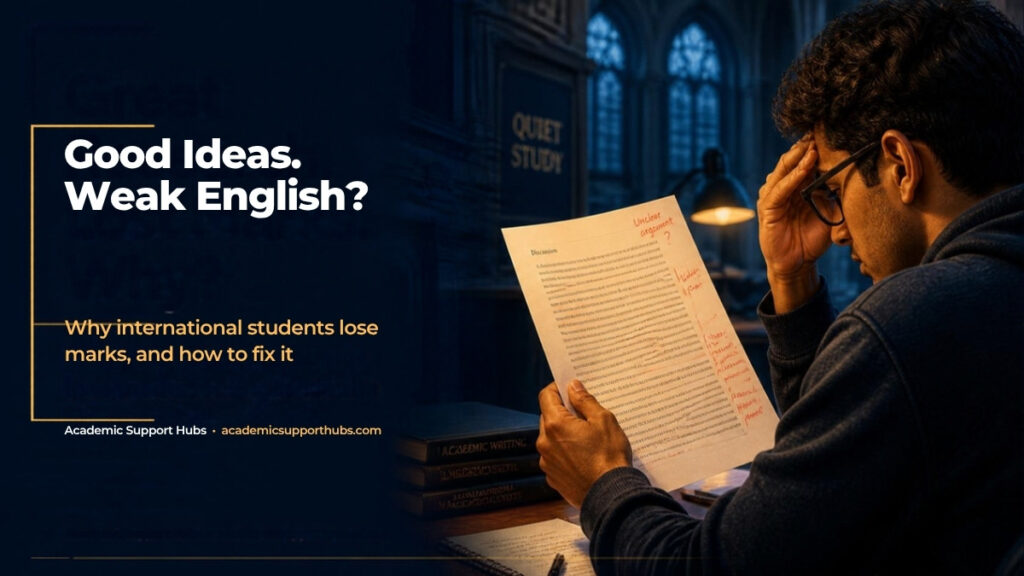
Every year, international students lose marks not because their ideas are weak, but because of how those ideas are expressed. If English isn’t your first language, this can feel deeply unfair — your argument might be sharp, your research solid, and still the mark comes back lower than you expected. Here’s what’s actually happening, and what you can do about it.
It’s rarely about grammar mistakes
Most international students assume they’re losing marks for grammatical errors — a missing article, a wrong preposition. In practice, markers are far more forgiving of small slips than students expect. What actually costs marks is clarity: sentences that are grammatically correct but hard to follow, ideas that are technically expressed but not clearly signposted, and academic voice that doesn’t quite match UK conventions. Grammar is the visible symptom; clarity is the real issue underneath it.
Long, layered sentences work against you
Many academic traditions outside the UK favour long, elaborate sentences as a sign of sophistication. UK academic writing generally favours the opposite: shorter, clearer sentences that carry one main idea each. When a sentence tries to hold three or four ideas together with multiple clauses, a marker has to work harder to follow your argument — and that effort gets read as unclear thinking, even when the thinking itself is sound. If a sentence takes more than one breath to read aloud, it’s usually worth splitting.
Formal phrases that read as dated or overly indirect
Phrases like “it is pertinent to mention that,” “the researcher would like to state,” or “kindly note that” are common in some academic traditions but read as old-fashioned or overly indirect in UK academic writing. Modern UK academic style tends to be more direct: “This study shows,” not “It is the belief of this researcher that this study demonstrates.” Direct, active phrasing reads as more confident — which, ironically, often earns better marks than more elaborate, formal language.
Signposting matters more than you’d think
UK markers rely heavily on signposting language to follow an argument: “This section will,” “Having established X, this next section considers Y,” “In contrast to the previous argument.” If your writing doesn’t tell the reader where it’s going, even a strong argument can feel disorganised. This is often the single biggest difference between a paper that reads as a 2:1 and one that reads as a first — not the ideas themselves, but how clearly they’re guided from one point to the next.
Passive voice, used too often, hides your argument
Passive constructions (“it was found that,” “the data was analysed”) are common in some formal writing traditions and aren’t wrong in UK academic writing either — used occasionally, they’re appropriate. But when overused, they can hide who’s doing the reasoning and make an argument feel distant or vague. A useful check: if you can add “by [someone]” to the end of a sentence and it still makes sense, you may be leaning on passive voice more than needed.
What actually helps
Reading your work aloud catches more issues than reading silently — awkward phrasing and overlong sentences are far more obvious to the ear than the eye. Beyond that, the fastest improvement usually comes from feedback that explains the pattern behind a correction, not just the correction itself. Being told “this sentence is too long” helps once. Understanding why UK academic writing favours shorter sentences helps for every sentence you write afterwards. That’s the difference between having your English corrected and actually improving it — and it’s worth looking for support that does the second, not just the first.
Related reading
- ASH Editing & Proofreading Service
- Why International Students Lose Marks for English in the UK
- Common Grammar Mistakes ESL Students Make
- Dissertation Writing Tips for Indian Students Studying in the UK
- 7 Common Dissertation Mistakes That Cost UK Students Marks
- How Much Does Dissertation Editing Cost in the UK?